
Notepad++ Supply Chain Compromise and Update-Hijack Vulnerability
Overview
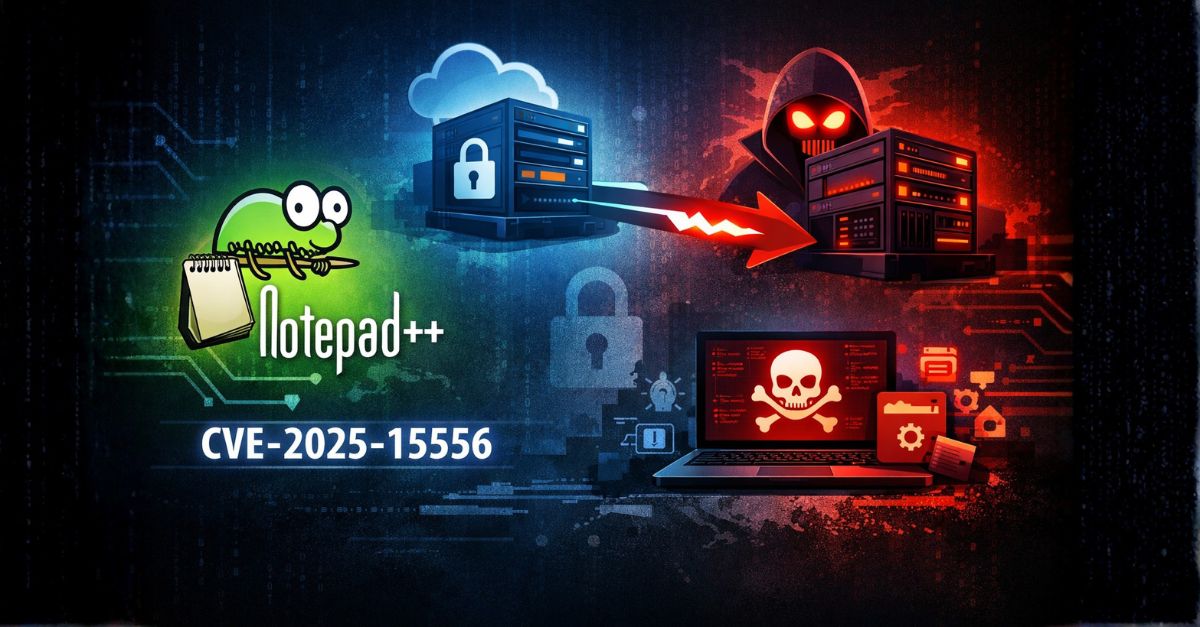
Notepad++, one of the most widely used text and source-code editors on Windows systems, became the focal point of a long-running supply chain compromise uncovered in early 2026. The incident did not stem from a traditional software vulnerability such as a buffer overflow or logic flaw in the editor itself. Instead, attackers exploited weaknesses in the update distribution process, allowing them to deliver malicious binaries under the guise of legitimate software updates.
Research indicates that between June and December 2025, threat actors gained control over infrastructure involved in Notepad++ update delivery. During this period, selected users who checked for updates were redirected to attacker-controlled servers hosting trojanized installers. These malicious updates executed with the privileges of the logged-in user, enabling arbitrary code execution without exploiting any local application bug.
The issue was later formalized as CVE-2025-15556, which describes insufficient integrity verification in the update mechanism used by affected versions of Notepad++. The vulnerability highlights how weaknesses in software delivery pipelines can be abused to bypass otherwise robust endpoint security controls.
How It Works
Notepad++ relies on a standalone updater component, commonly referred to as WinGUp (gup.exe), to manage version checks and update downloads. In versions prior to 8.8.9, this updater fetched update metadata and installer binaries over HTTPS but did not enforce strong cryptographic validation of the downloaded content.
From a technical perspective, the update flow operated as follows:
First, the updater queried an official update endpoint to determine whether a newer version was available. Second, the server response included a download location for the installer binary. Third, the updater downloaded the binary to the local system and executed it without validating a trusted digital signature or independently verifying file integrity.
This design meant that any attacker capable of manipulating update traffic — either through compromised hosting infrastructure, DNS manipulation, or upstream network access — could substitute a malicious installer. Once executed, that installer ran in the context of the current user, effectively granting the attacker a foothold on the system.
During the observed campaign, attackers leveraged this weakness to deploy custom malware payloads, often using multi-stage loaders and post-exploitation tooling. In several cases, the malicious installers performed reconnaissance, established outbound command-and-control connections, and prepared the system for additional payload delivery. The selective nature of the redirections strongly suggests targeted exploitation rather than indiscriminate mass malware distribution.
Risks
The technical risks associated with this incident extend beyond the immediate compromise window.
First, the vulnerability enables arbitrary code execution without exploiting a flaw in application logic, making it difficult for traditional vulnerability-centric defenses to detect or prevent. Systems running fully patched operating systems and endpoint protection solutions could still be compromised if the malicious update was executed.
Second, the selective targeting observed during the campaign reduces visibility and complicates detection. By only redirecting a subset of users, attackers minimized noise and avoided raising suspicion through widespread failures or obvious malicious behavior.
Third, the impact depends heavily on user privileges. On developer workstations, jump hosts, or administrative systems where Notepad++ is commonly used with elevated permissions, successful exploitation could enable lateral movement, credential access, and long-term persistence.
Finally, the incident underscores a systemic risk: implicit trust in update mechanisms. Even widely trusted, open-source tools can become attack vectors when the infrastructure responsible for delivering updates is compromised or inadequately secured.
Real Life Example Usage
In one documented attack chain, a tampered update binary was delivered via a redirected update request. When executed, the installer created new directories within the user profile, collected system information such as running processes and user context, and transmitted this data to an external server controlled by the attacker.
Follow-on stages involved downloading additional components that established persistent access and enabled interactive command execution. Security researchers observed tooling consistent with advanced intrusion frameworks, indicating that the update mechanism served as an initial access vector rather than the final payload.
This case demonstrates how compromising a trusted update channel allows attackers to bypass user skepticism entirely. From the user’s perspective, the process appeared identical to a routine software update, illustrating why supply chain attacks are so effective in real-world environments.
Recommendations
Organizations and individuals using Notepad++ in technical or sensitive environments should treat this incident as a concrete example of supply chain risk rather than an isolated anomaly.
All installations should be upgraded to Notepad++ version 8.8.9 or later, which introduces mandatory integrity and certificate checks for update packages. Systems that ran vulnerable versions during the mid-2025 compromise window should be reviewed for signs of unauthorized installer execution or suspicious outbound connections.
More broadly, this incident shows how even widely used, trusted tools can become an entry point when the infrastructure behind them is compromised. In modern software environments, security cannot stop at the application itself. It must extend across the entire delivery chain — from source code and build processes to hosting, update distribution, and client-side verification — especially as supply chain attacks continue to increase in frequency and sophistication.
Sources
-
Notepad++ Project – Hijacked Update Incident Disclosure
https://notepad-plus-plus.org/news/hijacked-incident-info-update/ -
CVE-2025-15556 – NVD Entry
https://nvd.nist.gov/vuln/detail/CVE-2025-15556 -
Ars Technica – Notepad++ updater compromised in supply chain attack
https://arstechnica.com/security/2026/02/notepad-updater-was-compromised-for-6-months-in-supply-chain-attack/ -
The Hacker News – Notepad++ update mechanism abused in targeted attacks
https://thehackernews.com/2026/02/notepad-official-update-mechanism.html -
Securelist / Kaspersky – Analysis of Notepad++ supply chain attack
https://securelist.com/notepad-supply-chain-attack/118708/